
Greece’s mainland often sits in the shadow of its islands, yet it holds some of the country’s deepest experiences. Ancient cities, mountain villages, long coastlines, and living traditions unfold across a landscape that feels both varied and cohesive. When travelers ask what to do in Greece mainland, the answer is not a single highlight but a layered journey through history, nature, and everyday life.
Unlike the islands, the mainland rewards slower travel. Distances are longer, but transitions feel meaningful. You move from classical ruins to alpine scenery, from quiet fishing towns to vibrant urban centers. Roads follow valleys and coastlines, and each region carries its own rhythm. The mainland is also where modern Greece and ancient Greece coexist most visibly, often within the same afternoon.
This guide explores what to do in Greece mainland with a practical, experience-led approach. You will see how to shape a journey that balances culture, landscape, and comfort, without rushing from one headline sight to the next.
Explore Athens Beyond the Obvious
Athens is the natural starting point for most mainland journeys. The city holds layers of history that stretch from classical antiquity to the present day. The Acropolis dominates the skyline, yet the experience of Athens deepens once you move beyond its most photographed monuments.
Walking through neighborhoods such as Plaka and Anafiotika reveals how the city folds around its past. Narrow lanes, small churches, and hidden courtyards soften the scale of ancient ruins. Museums such as the Acropolis Museum provide essential context, but everyday scenes matter just as much. Cafés fill from morning, markets hum with routine, and evenings unfold slowly in local tavernas.
Athens rewards time. Staying a few days allows you to explore on foot, visit lesser-known archaeological sites, and understand how the city functions as a living capital rather than an open-air museum.
Rating: ⭐⭐⭐⭐⭐
Highlight: A layered city where ancient history and modern life coexist naturally.
Visit the Monasteries of Meteora
Meteora feels almost unreal when you first arrive. Massive stone pillars rise abruptly from the plain, topped by centuries-old monasteries. The setting creates one of Greece’s most striking landscapes, shaped by geology and spiritual tradition.
Visiting Meteora involves both physical movement and quiet observation. Stone paths and steps connect viewpoints and monasteries, offering changing perspectives as light shifts across the rocks. Inside the monasteries, you find frescoes, courtyards, and moments of stillness that contrast sharply with the dramatic exterior.
Meteora suits travelers who appreciate atmosphere as much as architecture. You do not rush through this region. You walk, pause, and absorb the scale of the surroundings. Overnight stays allow you to experience early mornings or evenings when tour groups thin and silence returns.
Rating: ⭐⭐⭐⭐⭐
Highlight: A unique blend of natural spectacle and spiritual heritage.
Discover Classical Greece at Delphi
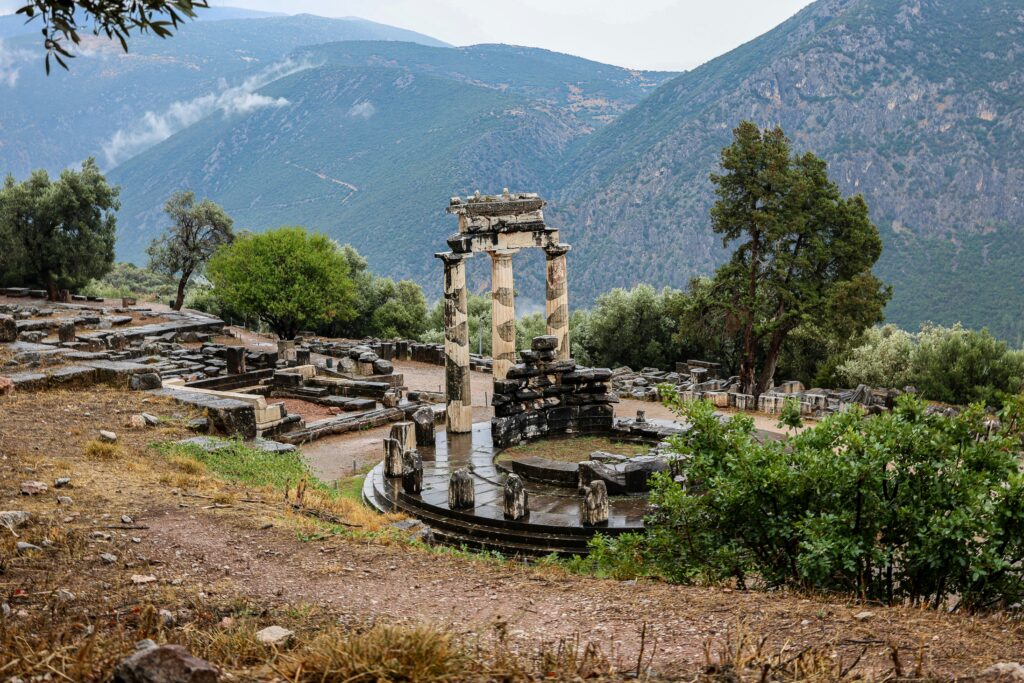
Delphi occupies a commanding position on the slopes of Mount Parnassus. In ancient times, it was considered the center of the world. Today, it remains one of the most evocative archaeological sites in Greece.
The experience unfolds vertically. You walk uphill past temples, treasuries, and the ancient theater, with views opening across the valley below. The site’s power lies not only in its ruins but in its setting. Landscape and mythology intertwine here, creating a sense of purpose that transcends stone.
A visit to Delphi pairs well with time in nearby mountain villages or coastal towns. This combination highlights how mainland Greece connects cultural landmarks with everyday environments.
Rating: ⭐⭐⭐⭐
Highlight: Dramatic setting that enhances historical understanding.
Travel Through the Peloponnese
Peloponnese is one of the richest regions for travelers asking what to do in Greece mainland. The peninsula combines archaeological depth, varied landscapes, and strong local identity. Distances are manageable, making it ideal for road trips.
Ancient sites such as Epidaurus and Mycenae anchor the historical narrative, while medieval towns like Nafplio add texture. Coastal drives reveal quiet beaches and fishing villages, and inland routes pass through olive groves and mountain terrain.
The Peloponnese suits travelers who want variety without fragmentation. You can balance culture, nature, and cuisine within a single region, often without heavy crowds.
Rating: ⭐⭐⭐⭐⭐
Highlight: A self-contained region offering history, scenery, and authenticity.
Experience Northern Greece’s Mountain Regions
Northern mainland Greece introduces a different mood. Regions such as Epirus and Zagori emphasize stone villages, deep gorges, and alpine landscapes. Life here feels quieter and more seasonal, shaped by weather and geography.
Zagori villages are known for their stone architecture and arched bridges. Walking paths connect settlements, encouraging exploration on foot. The Vikos Gorge, one of Europe’s deepest, offers dramatic hiking opportunities for those seeking nature-based experiences.
This part of Greece mainland suits travelers who value scenery and slow movement. Accommodation tends to be small-scale, and meals reflect regional traditions rather than tourist trends.
Rating: ⭐⭐⭐⭐
Highlight: Mountain landscapes and preserved village life.
Relax Along the Mainland Coastlines
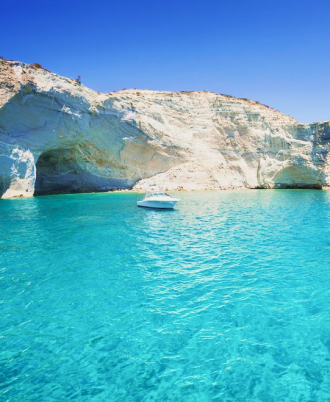
The mainland’s coastline often surprises travelers accustomed to island beaches. Long stretches of sand, clear water, and lower density define many areas. Unlike islands, these beaches are often paired with working towns rather than seasonal resorts.
Regions such as the Corinthian Gulf, the Peloponnese coast, and parts of Thessaly offer swimming conditions comparable to islands, with easier access by car. You can combine beach time with inland exploration without changing accommodation frequently.
Mainland beaches suit travelers who want space and flexibility. Facilities range from organized areas to natural stretches, allowing you to adjust your day without rigid planning.
Rating: ⭐⭐⭐⭐
Highlight: Accessible beaches with fewer crowds than major islands.
Engage With Food and Wine Traditions
Food is central to understanding Greece mainland. Agricultural regions shape local cuisine, and menus change as you move across the country. Olive oil, wine, cheese, and seasonal produce appear consistently, but preparation varies.
Wine regions such as Nemea and Naoussa invite visits to small producers, where tastings feel personal rather than commercial. In rural tavernas, meals follow the pace of the kitchen rather than the clock. Dining becomes an experience of time as much as flavor.
This aspect of mainland travel appeals strongly to mature travelers who value authenticity and connection over novelty.
Rating: ⭐⭐⭐⭐⭐
Highlight: Regional cuisine rooted in landscape and tradition.
Understand Greece Through Its Roads
One of the most rewarding answers to what to do in Greece mainland is simply to drive. Roads link coast to mountains, cities to villages, and past to present. A road trip allows you to stop where interest arises rather than where schedules dictate.
Driving reveals the scale of the country. You see how geography shapes settlement patterns and daily life. Small stops, roadside cafés, and unexpected viewpoints often become the most memorable moments.
Rating: ⭐⭐⭐⭐
Highlight: Freedom to explore beyond fixed itineraries.
Comparison: What to Do in Greece Mainland
| Experience | Best Region | Atmosphere |
|---|---|---|
| Urban culture | Athens | Vibrant, layered |
| Spiritual landscape | Meteora | Quiet, dramatic |
| Classical heritage | Delphi | Reflective |
| Regional exploration | Peloponnese | Varied |
| Nature and hiking | Zagori | Remote |
| Beach time | Mainland coasts | Relaxed |
| Food and wine | Multiple regions | Authentic |
Final Thoughts: Greece Mainland as a Complete Journey
The Greece mainland offers a sense of completeness that islands alone cannot provide. You encounter history where it unfolded, landscapes that shaped communities, and traditions that continue without performance. Experiences feel connected rather than curated.
What to do in Greece mainland depends on how you travel. You can focus on classical sites, nature, food, or a blend of everything. The mainland supports depth, allowing you to stay longer in each place and understand it more fully.
For travelers seeking substance, variety, and a calmer rhythm, mainland Greece delivers enduring value. It invites you not just to visit, but to move through the country with intention, discovering how its past and present remain closely intertwined.